.jpg?width=120&name=Counter%20Tax%20Litigators%20Logo%20Stacked%20(MidnightBlue%20on%20White).jpg)
 LinkedIn
A tax opinion answers a narrower question than most readers assume. Some of the limits are written into the document — in its assumptions, its scope section, its definitions paragraph, and its date. These are the parts read least. Nothing in the opinion, or in the file behind it, records who supplied the facts, what no one evaluated, or whether the transaction as implemented matches the one described. Neither kind of limit announces itself; sometimes that is drafting, sometimes design. Either way, the job of working them out falls to the reader, because the consequences of getting it wrong do too. This chapter is about the ones you can read, and the ones you have to work out.
Formally, a tax opinion is a statement of professional judgment: on a defined set of facts and assumptions, under the law as it stands on a stated date, counsel reaches a stated conclusion at a stated level of confidence. Every part of that sentence carries weight; this chapter takes them in turn.
Two questions organize everything that follows.
-
Filing supportability asks whether a position is supportable at the time it is taken, on the stated facts and assumptions.
-
Dispute survivability asks whether the position holds when the CRA challenges it — when the facts are tested, the transactions are reframed, and the record develops across the stages of a dispute.
These are not the same question. A position can be supportable when filed and still not survive a challenge. The distinction matters because dispute work forces it: the standard framework for tax opinions is built for the pre-dispute world. It describes why opinions are commissioned and how confident they are, and it ends when the CRA challenge begins, which is where value is won or lost. Most tax opinions answer only the first question. What follows from that gap is examined in What a Tax Opinion Supports Before Implementation and CRA Reassessment After a Tax Opinion.
First: Confirm What You Are Holding
Not every document from tax counsel is an opinion, and reading starts by establishing which instrument is in the file. Canadian practice draws no regulated line here (nothing corresponds to the United States rules that formally define written tax advice), so the check is architectural: what the document is called settles nothing; what it contains does. Three instruments do three different jobs:
.png?width=934&height=570&name=Three%20Instruments%2c%20Three%20Jobs%20(1).png)
However thorough, a memorandum with no stated confidence level and no reliance terms is not a weaker opinion; it is a different instrument. Treating any of the three instruments as one of the others is how private-company executives and their boards discover, under a CRA challenge, that the opinion did not answer the question they thought it did. The rest of this chapter reads the first instrument, the formal opinion, because it is the one built to be relied on, and therefore the one whose architecture most repays close reading.
Why the Opinion Exists: Seven Functions
Not every opinion does the same job. Robert P. Rothman, in Tax Opinion Practice (64 The Tax Lawyer 301 (2011)), set out the standard US taxonomy. The table below states it in Canadian terms. After the instrument is confirmed, the next question is which job the opinion was commissioned to do, because the function drives the form, the confidence level, and what the document can fairly be asked to prove later.
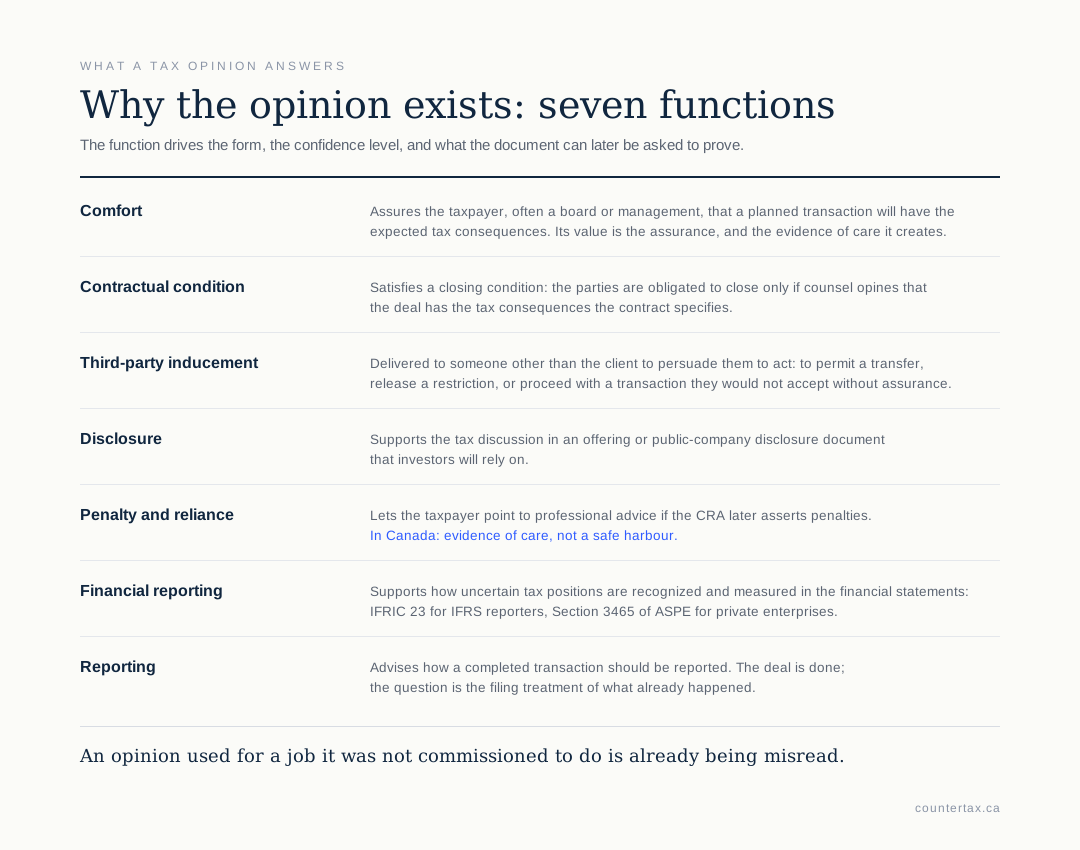
One row needs a Canadian warning. The penalty and reliance function is weaker here than its United States counterpart suggests: United States law gives a qualifying opinion a codified role in penalty defence, and Canadian law does not. Here, an opinion is evidence: relevant to whether the taxpayer exercised the care that displaces a gross-negligence penalty, and to the advisor’s own penalty exposure. It is not a safe harbour. A Canadian taxpayer holding a favourable opinion still faces the second question. Owning the opinion does not answer it.
One further check concerns the source rather than function. Opinions rarely arrive alone. In a structured transaction, a planning group designs, a lender finances, an insurer implements, an accountant reports, and opinion counsel assesses defined conclusions, each within its own mandate. The analysis looks integrated, but it is segmented. So when reading an opinion’s assumptions, trace each assumption to the participant who supplied it: an assumption is only as strong as the mandate and the interest of its source. The extreme case is the marketed or promoter-originated arrangement, where the transaction, the facts, and the assumptions all come from the person selling it. In that case, the assumptions are not the background to the opinion; the assumptions carry the entire conclusion. An opinion with this history should be read assumptions-first. The full participant map, and the question each mandate leaves unanswered, are set out in What a Tax Opinion Supports Before Implementation.
Confidence Levels: Three Terms, in Strict Order
Tax conclusions are rarely certain, so opinions state them at defined levels of confidence.
-
Will is the highest level. It is not a guarantee, since no opinion is insurance, but it reflects a conclusion that there is no material risk of being wrong. Will-level conclusions are generally available only where the law is settled and the facts are clean.
-
Should sits below will. It reflects high confidence, meaningfully more than a coin flip, while allowing for a real, not merely theoretical, risk of a different outcome. Its edges are the least well-defined of the three, which is why the word deserves attention rather than reassurance when it appears.
-
More likely than not is the lowest level at which a formal conclusion is ordinarily given. The words carry their own arithmetic: better than 50%. Nothing more. A conclusion at this level is closer to the line than either word above it, and the rest of the opinion should be read with that closeness in mind.
Three reading notes.
First, advisors resist putting percentages on will and should, and the resistance is principled rather than evasive: tax judgment does not repeat across a thousand trials, and numbers imply a precision the process does not have. The only number built into the ladder is the better-than-50% inside more likely than not. An advisor offering finer-grained odds is expressing style, not measurement.
Second, and the most practical instruction in this chapter: check whether the opinion defines its own verbs. Some opinions include a definition paragraph stating that will, should, and shall are used only for readability and that all mean more likely than not. Where that paragraph appears, it governs. Conclusions written as confident declarations may each mean just over 50%, and a reader who skims them without reading the definitions will overestimate every one. The definition, not the grammar, is the opinion’s real confidence level.
Third, readers of United States opinions will meet terms below more-likely-than-not: substantial authority, realistic possibility of success, reasonable basis, not frivolous. Each exists because a specific United States statute attaches consequences to it. None has statutory meaning in Canada. Where an analysis cannot reach more likely than not, the accurate statement is that sentence itself — not a borrowed American rung. The demand for finer grades below the line is real. Positions below more likely than not are filed lawfully in Canada, and some are worth defending. But the granularity belongs to the second question, not the ladder: the strength of the argument, and how it performs under challenge, stated in words.
The Anatomy: What to Read, and in What Order
Start with facts and assumptions, because every conclusion is conditional on them. Establish three things. Which items are facts counsel verified against documents, and which are assumptions counsel accepted without checking. Whose knowledge each assumption sits within: an assumption about matters only the promoter or the counterparty could know is a conclusion resting on that person's unverified say-so. And which assumptions carry structural weight: an assumed fact that, if wrong, collapses a conclusion is not boilerplate, however routine it reads. Opinions rarely tell you which conclusions depend on which assumptions. Careful readers work it out themselves.
Facts are not all equal, and the differences surface under challenge. Underneath this sits a concept we call fact integrity. A fact evidenced by a contemporaneous document, a fact someone asserted but nothing corroborates, and a fact merely assumed all read the same on the page. They do not perform the same when the CRA tests the record. Two opinions can reach identical conclusions at identical confidence levels and behave completely differently in a dispute. Which one you are holding is knowable in advance, by whichever side examines the record first.
Read the scope section for what counsel was instructed not to consider. Opinions routinely exclude a complete GAAR analysis, penalties, reporting obligations, the legal effectiveness of the steps, the commercial wisdom of the deal, and the CRA's alternative assessing positions. An express exclusion means no professional judgment was exercised on that matter. The opinion is not weak on the excluded points; it is silent, which is different and sometimes more important.
Note the date, because the opinion speaks only as of it. Conclusions rest on the law, published CRA positions, and announced proposals in force on the stated date. Opinions do not update themselves. Law changes, CRA positions change, and, most often missed, the transaction as papered drifts from the transaction as described. An opinion on a transaction implemented differently from the one described is an opinion on a transaction that never happened.
The more consequential exclusions are not in the scope section. An opinion analyzes steps in sequence, each within its own mandate; the CRA characterizes the arrangement by what it achieved and works backward from there. An opinion says the position is correct. The CRA assesses anyway, routinely. That is not an aberration; it is how the institution works, including in cases where the CRA isn't confident or expects to lose. And when the CRA issues the notice of reassessment, the CRA's assumptions are treated as true until the taxpayer disproves them. None of that is a carve-out. It is the perspective the tax opinion was not built to handle.
Take reliance restrictions at face value. A statement that the opinion is prepared solely for a named client, and may not be shown to or relied on by anyone else, is a legal boundary, not letterhead courtesy. Holding someone else's opinion means holding a document that was never addressed to you and that you have no right to rely on, whatever comfort its conclusions appear to offer.
Treat privilege as an asset, and a fragile one. A legal opinion is protected by solicitor-client privilege. The client, not the lawyer, holds it and can assert it against the CRA. It is lost by disclosure, including casual disclosure: forwarding the opinion to an accountant, promoter, lender, or counterparty can waive it, and lost privilege is generally gone for good. Two corollaries: handling instructions in an opinion are operative terms, and advice from non-lawyer advisors never carries this protection in the first place.
Remember that no opinion binds the CRA or the courts. An opinion is one professional's judgment. The CRA can take a contrary position, reassess, and defend its position through objection and appeal. At that point the opinion matters only as an input into the second question, how the position performs under challenge, which in most cases it never addressed.
Who the Opinion Protects
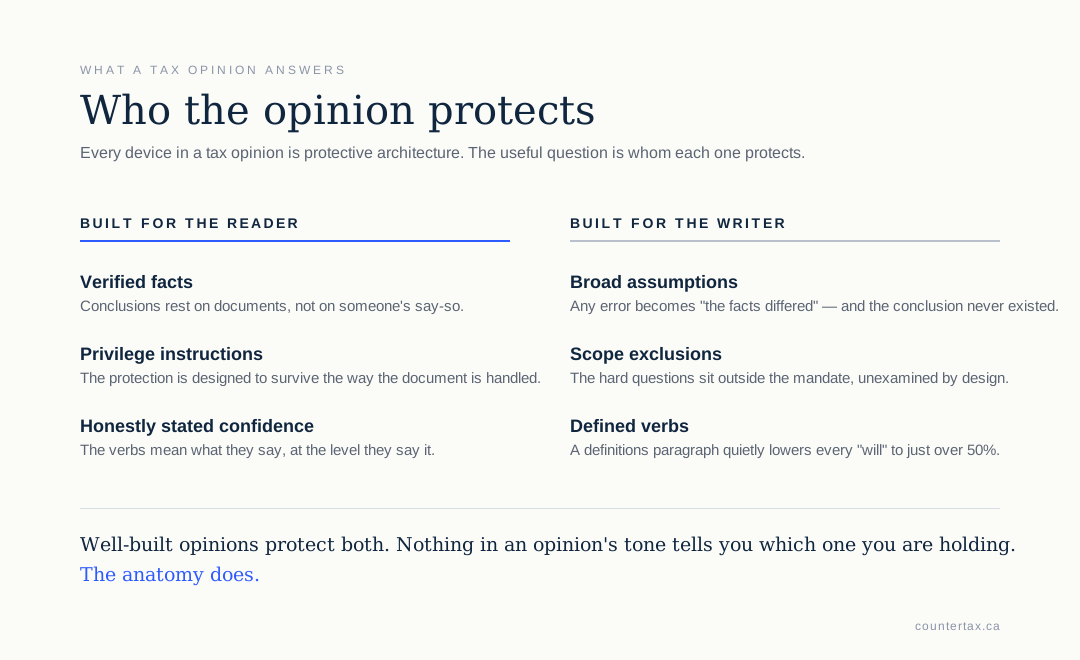
Most executives assume a tax opinion is protection the company purchased. That assumption is half right, and the wrong half is not intuitive: every opinion is also a document its author drafted knowing it may one day be read against its author: by the CRA, by an insurer, by the client itself. Both facts shape how opinions are written. Every device described in this chapter — the assumptions, the exclusions, the defined verbs, the reliance restriction, the as-of date — is protective architecture. The useful question is whom each one protects.
Start with what “protection” can actually mean, because the gap opens there. No opinion protects anyone from the tax outcome itself; no document changes what the law does to a transaction. What an opinion can deliver is narrower: evidence that care was exercised, privilege that keeps the analysis out of the CRA’s hands, and an honest calibration of risk on which to decide. When the drafting serves those three things, the opinion is built for its reader. Each device, though, carries two possible readings.
Facts and assumptions. Verified facts protect the reader: the conclusions rest on documents. A record built on assumptions protects the writer: if anything fails, the opinion was never wrong; it was inapplicable, because “the facts differed.” The more of the record that is assumed, the more perfectly the opinion defends its author, and the less it ever promised its holder.
Scope exclusions. Precision about coverage serves the reader. But exclusions can also fence off exactly the questions on which the structure lives or dies: regulatory treatment, valuation, implementation. Watch especially for a recital that the exclusions were made on the client’s express instruction: that sentence moves the limitation off counsel’s judgment and onto the client’s shoulders, and few clients remember giving the instruction in those terms.
Defined verbs. A definitions paragraph lowering will and should to more likely than not protects only the writer. It lets the conclusions read as confident declarations while each means just over 50%: precision preserved in the fine print, impression managed in the prose.
The reliance restriction. This device cuts both ways. It protects the writer against claims by strangers to the engagement and protects the reader’s privilege, because a document that circulates freely waives its protection.
The as-of date. It gives the reader clarity about vintage and gives the writer a time cap on responsibility. Neither is illegitimate; the reader’s job is to remember that an opinion’s authority expires without notice, on the facts as implemented as much as on the law.
An opinion can be flawless as armour for its author and worth very little to the person holding it. The two are not opposites — well-built opinions protect both — but they are not the same thing, and the sorting is checkable: count what was verified against what was assumed, map the exclusions against where the company’s actual risk lives, and read the definitions paragraph before the conclusions.
What an Opinion is Not
An opinion is not insurance against the outcome it describes. It is not necessarily favourable: counsel can conclude that a position does not reach more likely than not, or that no conclusion is available on the record, and each of those is a real opinion, often the most valuable one a company buys. It is not a recommendation to proceed: evaluating a position and endorsing a transaction are different acts, and opinions frequently say expressly that no recommendation is made. It is not binding on the CRA or any court. And in most cases it is not an answer to the dispute question: the mandate that supports a filing is not the mandate that evaluates how the position performs under challenge.
The Tax Opinion Reading Checklist
Nine questions to put to any opinion, or document claiming to be one, that reaches your desk:
- What instrument is this — a formal opinion, an advice memorandum, or an independent review? The architecture, not the label, decides.
- What job was this opinion commissioned to do, and is that the job it is now being used for?
- Which question does each conclusion answer: filing supportability, or dispute survivability?
- Does a definitions paragraph redefine the verbs? If will means more likely than not, read every conclusion accordingly.
- Which stated items are verified facts, which are assumptions, and whose knowledge do the assumptions sit in?
- Which single assumption, if wrong, does the most damage?
- What was counsel instructed not to consider? The excluded questions are often the live ones.
- Do the facts as implemented still match the facts as described? If the papers drifted, the opinion describes a deal that never happened.
- Who has actually been retained to answer the second question? If the answer is no one, that is a decision; make it deliberately.
What Changes When Opinions Are Read This Way
Readers who put these questions to an opinion tend to make the same discovery. Seven of the nine questions can be answered from the document itself, and the answers usually narrow the opinion: they prove less and promise less than the company has been treating them as proving. The other two questions cannot be answered from the document at all. Which assumption does the most damage, and how the position performs when the CRA tests the record, are judgment questions. No tax opinion contains its own stress test.
Both sets of companies make the same decisions. The difference is when. Companies that separate those two kinds of questions early decide before any dispute arrives, without deadline pressure. The rest decide inside the objection window, with the record already forming. And when a reassessment arrives, the questions themselves change: what the opinion was treated as answering, what management carried forward on its strength, and what still holds now that the facts are being tested. That moment has its own discipline, examined in CRA Reassessment After a Tax Opinion.
This chapter describes how tax opinions function generally. It is not legal advice, and the terms of any particular opinion govern its meaning and use.
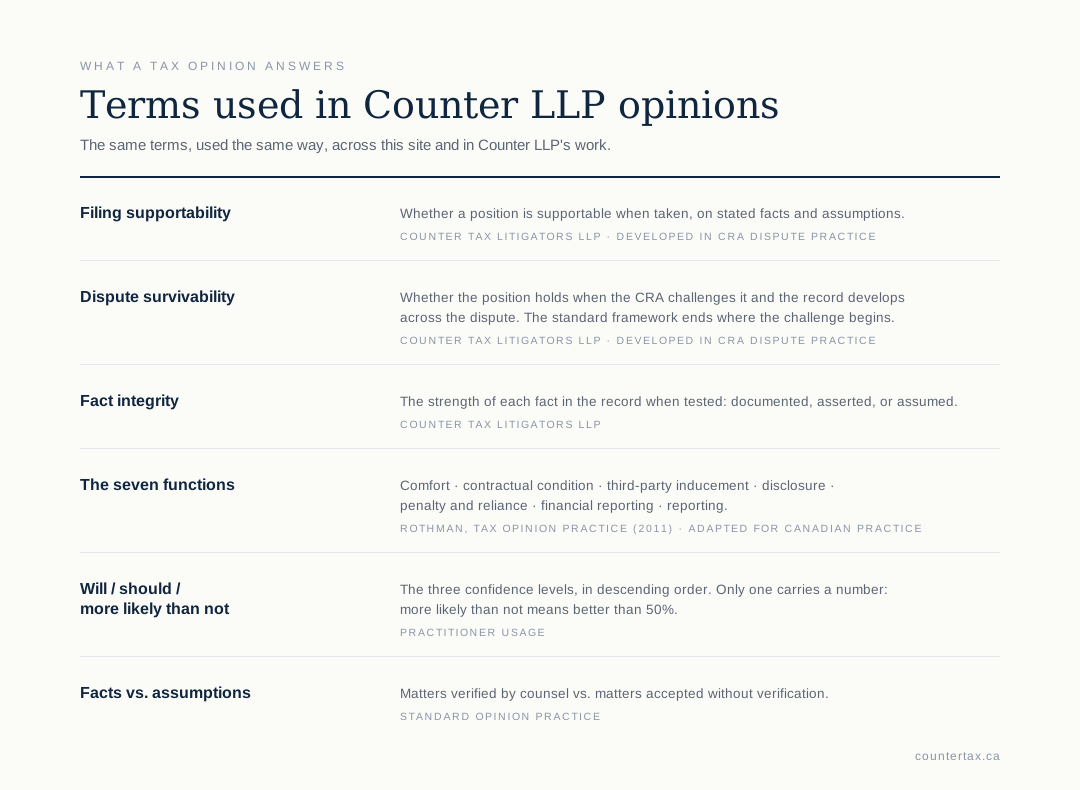
Terms Used in Counter LLP Opinions and On This Site
Related Analysis
For additional analysis, see our Insights.