.jpg?width=120&name=Counter%20Tax%20Litigators%20Logo%20Stacked%20(MidnightBlue%20on%20White).jpg)
 LinkedIn
Key Takeaways
- The reassessment shows the financial exposure. What moves forward depends on how the taxpayer frames the dispute in the Notice of Objection.
- In this case, the taxpayer’s Notice of Objection failed in a clear way. In most disputes, taxpayers do not see the failure as clearly.
- Taxpayers and their advisors often miss strategic and Notice of Objection failures, which narrow both the arguments and the range of outcomes.
The Situation
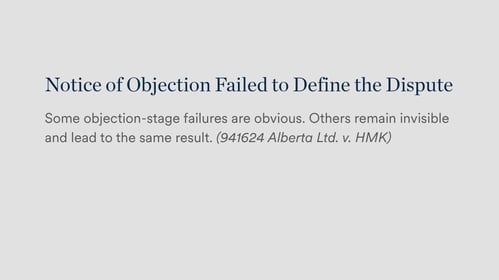
941624 Alberta Ltd. appealed reassessments involving unreported income and denied expenses. Because the company was a large corporation, it had to meet the specific objection requirements under the Income Tax Act to preserve its appeal rights. The ITA imposes these requirements through the large-corporation objection rules, including subsections 165(1.11) and 169(2.1), which define what can move forward on appeal. The taxpayer stated only that the reassessments were incorrect and that the returns were correct as filed. The Court held that the taxpayer had not properly raised any issues and quashed the appeals for the relevant years, leaving nothing for the Court to decide.
What Made the Difference
The outcome turned on what the advisors actually put into the Notice of Objection. The advisors did not define any issue in the objection in a way that the Court could work with. The taxpayer attempted to rely on the audit and later materials to explain the dispute. The Court looked only at what the taxpayer had set out in the Notices and treated the absence of defined issues as decisive. The taxpayer put nothing in place that could carry forward into the next stages, so there was nothing for the Court to decide.
Why this case is useful
This was not a file that lost on the facts or the law. It was a file that never took shape in a way the system could use.
That makes the problem easy to see here.
In many files, the same issue does not show up this clearly. The objection is filed, the file continues, and the limits only become clear later, when the ability to change direction has already been reduced.
The Signal for Business Leaders
This case shows the issue in its clearest form. The taxpayer’s error at the objection stage was obvious, and the Court moved quickly to its result. In many large-corporation disputes, the same issue appears less clearly. The taxpayer files the objection, and the file moves forward, and the problem only shows up later when the taxpayer can no longer change position easily, arguments are narrower, or the ability to take a different approach has already been reduced.
The reassessment shows the financial exposure. The taxpayer and their advisors often set what will shape the outcome at the objection stage, without the same visibility. It turns on what the taxpayer sets out, what they leave out, and how the issue is framed at that stage, not just on the underlying facts. Courts tend to work from what the parties put into the record, rather than revisit what was not clearly put forward.
In many files, the taxpayer and their advisors do not identify the point that later limits the dispute. It does not present itself as a clear mistake. It shows up later, when the taxpayer faces a narrower range of arguments or outcomes, without a single moment when anyone clearly changed the file. The large-corporation objection rules make this visible in this case. In practice, similar issues arise throughout the file, often without the taxpayer or their advisors recognizing them at the time.
941624 Alberta Ltd.’s failure was obvious.
That kind of failure is rare.
What usually limits the outcome is not.
Case Reference: 941624 Alberta Ltd. v. HMK, 2026 TCC 67
For additional analysis, see our Insights.