.jpg?width=120&name=Counter%20Tax%20Litigators%20Logo%20Stacked%20(MidnightBlue%20on%20White).jpg)
 LinkedIn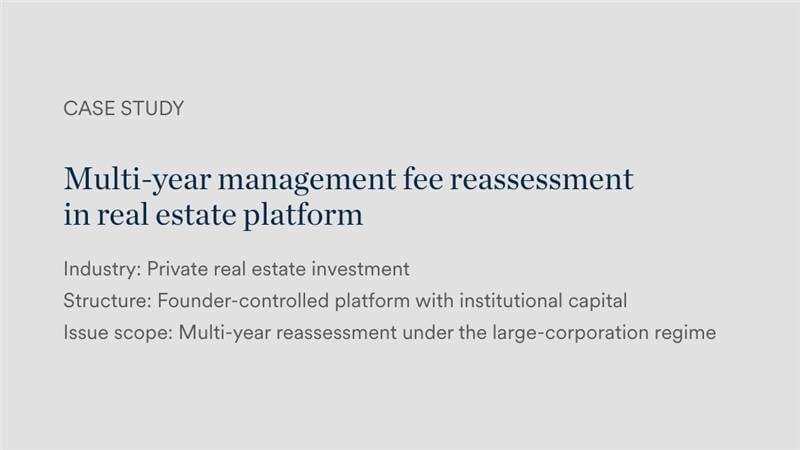
Reassessment
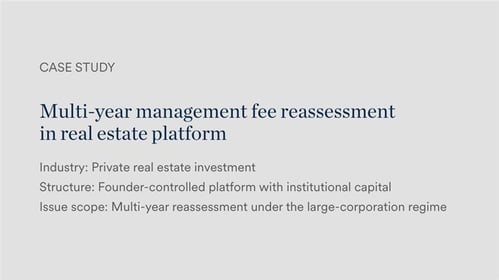
The Canada Revenue Agency reassessed multiple taxation years and challenged the deductibility of management fees charged within the platform.
The Agency did not dispute that services were performed.
It asserted that certain functions duplicated asset-level activity, that fee levels exceeded arm’s-length benchmarks, and that a portion of the fees reflected profit extraction rather than compensation.
The reassessment adopted a defined interpretation of how management authority and operating functions were distributed across the platform.
Structure
A real estate investment platform operated through a centralized management entity overseeing a portfolio of property-level entities.
The management company directed:
- capital allocation across assets
- portfolio-level financing and refinancing
- lender negotiations and covenant management
- disposition timing and hold strategy
- sponsor guarantees
Individual properties were held in separate legal entities.
Strategic decisions affecting financing, capital deployment, and disposition were made centrally.
As the portfolio expanded and financing structures became more complex, management fees increased in absolute terms.
Dispute
The dispute did not turn on contractual documentation.
It turned on where the platform’s strategic authority and financing risk actually resided.
How CRA evaluates management fee structures in investment platforms
In real estate platforms, CRA focuses less on the existence of management agreements and more on where economic control and operating risk sit within the structure.
The Agency examines whether:
- centralized management performs functions beyond property-level activity
- financing risk and sponsor guarantees sit at the management level
- management activity replaces or merely duplicates asset-level functions
Where fee structures expand alongside platform growth, CRA may treat a portion of those fees as profit extraction rather than compensation for services.
The dispute turns on how centralized authority is interpreted across the platform, not simply on the existence of management contracts.
Competing Characterizations
| Issue | CRA's Position | Company's Position |
|---|---|---|
| Nature of the fees | Profit extraction because fee levels increased as the portfolio scaled. | Compensation for centralized management because the management entity directed portfolio-level strategy. |
| Source of management activity | Duplicative services because certain functions occurred at the asset level. | Centralized oversight because financing strategy, lender negotiations, and capital allocation were directed centrally. |
| Economic role of the management entity | Administrative function because properties operated through separate entities. | Strategic decision center because portfolio-level financing and risk management were controlled centrally. |
| Effect of scale | Evidence of excess fees because growing fee levels indicated profit extraction. | Evidence of necessity because larger portfolios required centralized oversight and financing management. |
Exposure
The reassessment created exposure across several areas:
- multi-year denial of management fee deductions,
- income reallocation within the platform, and
- broader scrutiny of the platform’s operating model.
Resolution
The dispute was reframed around centralized decision-making authority and financing exposure.
Throughout the dispute, reporting to the board and institutional capital partners remained aligned with that reframed theory. The dispute remained confined to the management fee issue.
The reassessment was reduced.
For additional analysis, see our Insights.
.png?width=499&height=299&name=Interest%20deductibility%20reassessment%20in%20leveraged%20acquisition%20financing%20(Case%20Study).png)

.png?width=499&height=299&name=Cross-border%20profit%20allocation%20reassessment%20in%20a%20private%20equity%20platform%20(1).png)