.jpg?width=120&name=Counter%20Tax%20Litigators%20Logo%20Stacked%20(MidnightBlue%20on%20White).jpg)
 LinkedIn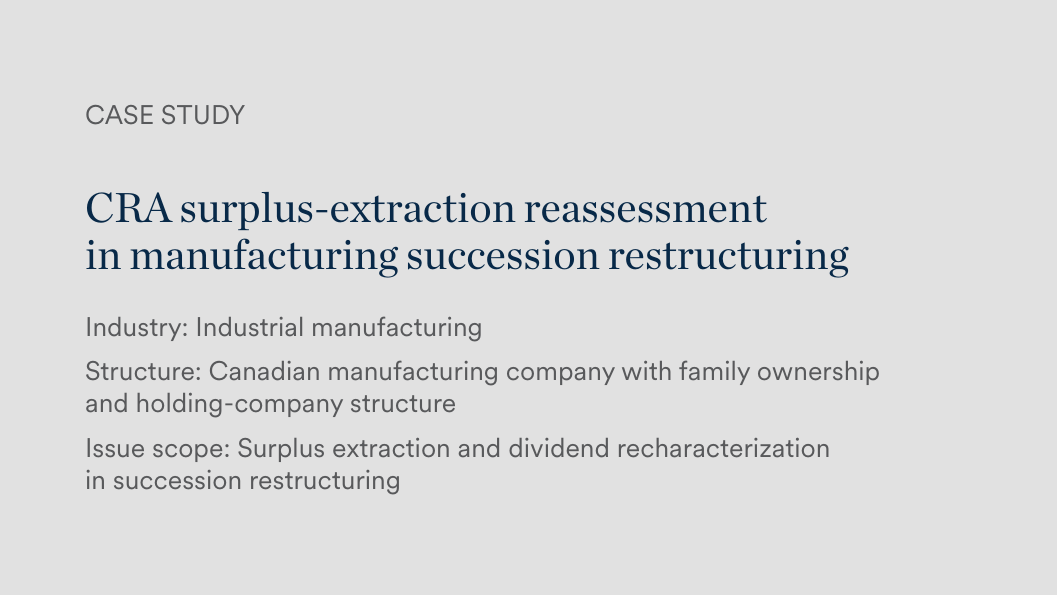
Reassessment
The Canada Revenue Agency reviewed a corporate restructuring undertaken as part of a long-term succession plan.
The Agency reassessed the taxation year in which the restructuring occurred and challenged the tax treatment of a share transfer completed within the ownership structure.
CRA did not dispute the value of the operating business or the existence of the succession plan.
It asserted that the restructuring effectively distributed accumulated corporate surplus, and that the amount reported as a capital gain should instead be treated as a dividend.
The reassessment adopted the position that the restructuring converted retained corporate value into shareholder proceeds.
Platform
The company supplied engineered components to North American equipment manufacturers through a centralized Canadian manufacturing and distribution platform.
The business had been started by siblings more than two decades earlier. One sibling primarily directed financing, ownership structure, and long-term planning while the other focused on operations.
The manufacturing business was held through a holding-company structure above the operating company.
As the company matured, the ownership group began implementing a long-term succession framework intended to transition ownership gradually while maintaining operational continuity.
The transition planning included:
- preparing senior managers for potential future equity participation
- separating operating ownership from longer-term family investment capital
- reorganizing the ownership chain to accommodate future ownership changes
Although the restructuring was driven primarily by one sibling, the implications affected several stakeholders, including family owners and long-standing commercial partners.
To support the transition, the operating company's shares were transferred to a revised holding structure designed to manage future ownership changes.
A portion of the founder’s economic value was crystallized through the restructuring.
Dispute
The dispute did not turn on valuation.
It turned on how the restructuring should be characterized under the surplus-extraction provisions.
How CRA evaluates succession restructurings
Succession restructurings often combine legitimate ownership planning with transactions that realize shareholder value.
When reviewing these structures, the Canada Revenue Agency focuses less on the valuation of the business and more on how corporate value reaches the shareholder.
In practice, CRA examines whether the restructuring:
- distributes retained corporate earnings through a corporate structure
- changes the economic ownership of the business
- reflects a genuine succession framework rather than a distribution of profits
The resulting dispute typically turns on how the restructuring is characterized under the ITA, rather than on accounting calculations alone.
Competing Positions
| Issue | CRA position | Company position |
|---|---|---|
| Nature of the transaction | Distribution of corporate surplus because the restructuring allowed shareholder value funded by retained earnings to be realized. | Succession restructuring because the transaction reorganized ownership to support a long-term transition of the business. |
| Source of value | Accumulated earnings because the operating company had built substantial retained profits over time. | Capital growth because the business value reflected decades of expansion, customer relationships, and goodwill. |
| Economic outcome | Corporate value flowed to the shareholder through the holding structure. | Ownership risk was reorganized, separating operating control from longer-term family capital. |
| Purpose | Conversion of dividends into capital gains through corporate structure. | Ownership transition planning intended to support generational and management succession. |
Exposure
The reassessment created:
- dividend recharacterization of the reported gain, and
- uncertainty affecting the company’s broader succession framework
Resolution
Before filing the notice of objection and throughout the dispute, the evidence and record were structured around the commercial purpose of the succession plan, along with the economic consequences of the restructuring.
The reassessment was reduced.
...
Further Analysis
From Tax Dispute Inflection Points
From Tax Dispute Caselaw & Signals
For additional analysis, see our Insights.
For additional analysis, see our Insights.
.png?width=499&height=299&name=Interest%20deductibility%20reassessment%20in%20leveraged%20acquisition%20financing%20(Case%20Study).png)
.png?width=499&height=299&name=Cross-border%20profit%20allocation%20reassessment%20in%20a%20private%20equity%20platform%20(1).png)