.jpg?width=120&name=Counter%20Tax%20Litigators%20Logo%20Stacked%20(MidnightBlue%20on%20White).jpg)
 LinkedIn
Key Takeaways
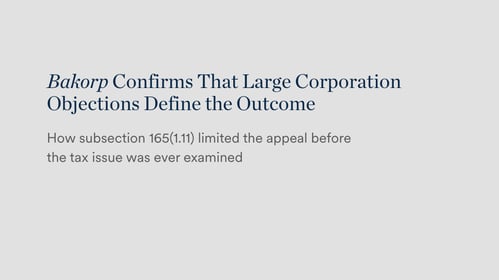
Under Income Tax Act s.165(1.11), a large corporation must reasonably describe each issue and the relief sought in its initial Notice of Objection.
Issues not described in the objection cannot later be raised in litigation.
For large corporations, the objection effectively sets the maximum recoverable scope of the dispute.
The Situation
Potash Corp., a large corporation within the meaning of s.165(1.11) of the Income Tax Act, appealed reassessments denying deductions for resource allowance and earned depletion.
In its Notice of Objection, Potash challenged the Minister’s treatment of specific income components used in the resource allowance calculation. The objection mirrored the categories and dollar amounts used in the reassessment.
During discoveries in the Tax Court litigation, Potash identified five additional items affecting the resource allowance calculation. These items had not appeared in the original return and were not described in the Notice of Objection. Potash attempted to introduce these items in the appeal.
The Federal Court of Appeal refused. Because the additional items were not reasonably described in the objection, they fell outside the dispute permitted under s.165(1.11).
What Made the Difference
The Court treated the large corporation objection regime as a boundary rule.
Section 165(1.11) requires the objection to provide the Minister with sufficient certainty about both:
-
the issues under dispute
-
the quantum of tax exposure
This allows the government to assess the nature and fiscal impact of potential tax litigation at an early stage.
Potash satisfied the rule for the issues it described by mirroring the Minister’s categories and amounts.
However, the additional computational elements identified later were not described in the objection. The Court therefore treated them as new issues, which s.165(1.11) prohibits large corporations from raising later.
The Court also rejected the argument that a general heading such as “Resource Allowance” preserved the right to contest every element of the calculation. The statute requires specificity.
The Signal for Business Leaders
For large corporations, the Notice of Objection defines the outer boundary of the dispute. Under s.165(1.11), that boundary generally cannot expand later. In practical terms, the notice of objection determines:
-
which amounts remain recoverable
-
which issues a court may examine
-
which positions never reach Tax Court review
This structure moves the dispute from audit management to dispute architecture. The notice of objection serves as the document that defines the case boundaries. After the notice of objection is filed, the strategy and positions do not extend beyond the parameters set in that notice.
Case Reference: Canada v. Potash Corp of Saskatchewan, 2003 FCA 471
...
For additional analysis, see our Insights.